
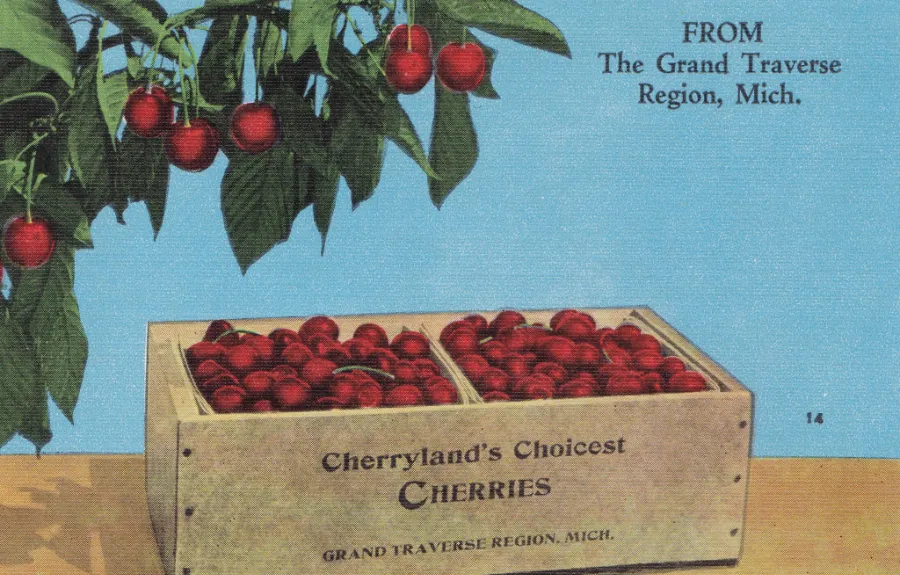
Cherry picking is a Traverse City staple, an annual event for locals and visitors alike. While casual picking is a pleasant way to spend a summer morning, Michigan’s cherry growers remain a vital part of the state’s agricultural output and a lynch pin of Traverse City’s identity.
Traverse City’s Cherry Industry’s Deep Roots
The story of cherries in Traverse City is rich and complex, and the region’s connection to cherries goes well beyond iconic events like the National Cherry Festival. Learn why cherries are grown in northern Michigan and why the fruit is a valued part of our area’s identity.
The History of Cherries
Cherries have been domesticated for thousands of years, originally in Anatolia (now Turkey). They were prized by the Romans and featured in the Silk Road trade for centuries before being transported to North America by European settlers in the 1600s.
The English word for cherry evolved from the name of the Greek region known for its cherry production. Kerasous became “cherry”, an everlasting tribute to an early cherry-producing powerhouse.
The Cherry Arrives in North America
Early settlers and colonists prized the cherry for its portability and the durability of its seeds. Cherry pits easily survived trans-Atlantic voyages and thrived in Colonial settlements. As Europeans moved westward in the 1780s and 1790s, cherries slowly expanded into Ohio, Indiana and, eventually, the wilds of Michigan.
Cherries on Old Mission Peninsula
The first cherry orchard in the Traverse City area was planted in 1852. Presbyterian missionary Peter Dougherty established an orchard on Old Mission Peninsula, and the industry took off. Before long, cherry orchards in Leelanau, Benzie, Wexford, and Antrim Counties grew, making northern Michigan a hub of cherry production.
Cherries benefit from northern Michigan’s unique microclimate. Lake Michigan adds considerable moisture to the air, which helps regulate sudden temperature changes, including those that produce damaging frost. The lake’s moderating effect is why vineyards, hop yards, and many other fruits and vegetables thrive in what would otherwise be a relatively cold climate.
Read more: The History of the State Hospital in Traverse City
The Cherry Capital of the World
Before long, Traverse City cherry orchards propelled the region to its title as “Cherry Capital of the World”, not just Michigan. To honor its impact and protect its future, local farmers organized the National Cherry Festival in 1926.
Today, the National Cherry Festival welcomes over half a million guests over its week-long festival, which includes air shows (including the Blue Angels), live musical acts, parades, and family-friendly fun. 85% of the 150 events are free, largely thanks to its sponsors and the 2,200 volunteers who make the festival possible.
Michigan’s Cherry Industry Today
Michigan typically supplies 70% of total US tart cherry production, but severe frost, including a spring cold snap in 2026, has negatively impacted output.
- Unpredictable weather, including frosts, heavy rain, and storms, led to intermittent shortages and pushed importers to find new cherry supplies.
- Tariffs and increased competition from Turkey and Chile have lowered cherry prices on the international market, hurting profits.
- Immigration policy has reduced the number of seasonal workers farmers rely on for planting and harvesting. Increased wages and labor shortages are making employment a burden for small farming operations.
- Increased land and property values have pushed traditional cherry growers to sell their farms to developers.
Many farmers have increased U-pick and direct-to-consumer sales through farmers’ markets and roadside stands to survive.
Where Else Are Cherries Grown in the US?
Michigan is one of the top cherry-producing states in the US, but most commercial cherry production occurs on the West Coast. Washington, California, and Oregon are the top three states for sweet cherry production, though Michigan remains the leader in tart cherries thanks to its Montmorency offering.
A Delicious Tradition
Cherries remain a treasured part of Michigan’s identity. Locals love picking cherries straight from the branch, and many still have ties to local cherry orchards or folks who work there. It’s a delight to see the first cherry blossoms each May and the tell-tale “spills” of cherries from trucks transporting them from the orchards to processors in town. Honor and support Traverse City’s agricultural legacy by donating to Traverse Regional History Center today.