
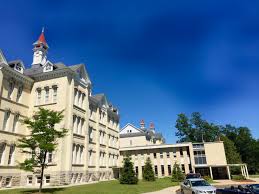
Today, the Village at Grand Traverse Commons is a thriving mixed-use development, with shops and housing naturally integrated into the historic grounds. Even during peak tourist season, it’s a calming, peaceful place to walk, shop, and experience. Every brick has a story to tell, however, and the history of the Traverse City State Hospital has played an influential role in the community’s development.
Learn more about the old State Hospital in Traverse City, from its initial purpose and promise to its eventual closure and revival.
Mental Health’s Early Roots in Traverse City: The State Hospital Opens
The history of the Traverse City asylum began in 1881. Founder Dr. James Decker Munson, who would eventually lend his name to Munson Medical Center on the same property, was a believer in restful, natural environments to alleviate mental health issues – given the blanket term “insanity” at the time – and led the charge to build the state’s asylum in Traverse City.
While Munson led the medical and psychiatric charge, the state of Michigan tasked local heavyweights Perry Hannah, E.H. Van Deusen, and M.H. Butler with site selection. At the time, Northern Michigan’s already established reputation as a resort time added to its appeal. The draw of West Grand Traverse Bay, just half a mile away, influenced the architectural design; the building was specifically angled to provide patients with a view of the water.
The architect of the Traverse City State Hospital was Gordon W. Lloyd, an English architect who gained popularity in the Midwest, designing churches, banks, and municipal buildings in Detroit, Saginaw, Flint, Ann Arbor, and many other cities. Much of his work in the Detroit area has been demolished, leaving the Traverse City State Hospital as perhaps the best example of his work.
Construction was completed in 1885, and the hospital welcomed its first 300 patients on November 30. Initially called the Northern Michigan Asylum for the Insane, it would become the Traverse City State Hospital two decades later, after Public Act Number 21 was passed by the Michigan State legislature in 1911.
Self-Sufficiency and Industry
Expanding from the primary building, Building 50, the campus was a hive of activity. In combination with other treatments, patients ran a laundry, gardened, canned fruits and vegetables, and built furniture. Occupation was a lynchpin of the organization’s treatment philosophy and paired well with exercise and fresh air.
Farming was a daily part of life at the asylum, and many of its patients came from farms and orchards in Northern Michigan and other parts of the thoroughly agricultural state. It took a decade to clear the property, and patients completed nearly every component of the work. Afterward, they also took on groundskeeper roles and other occupations critical to campus operations.
Patient Treatment
Earlier psychiatric treatments were quasi-medieval, and treatment in many facilities at the time would be barbaric by modern standards. While far from perfect, conditions at Traverse City State Hospital were far more humane. From 1888, staff recommended that restraints, isolation, and drugs should only be used in extreme cases. Instead, the emphasis was on making patients comfortable. Steady occupancy, fresh air, entertainment, and a degree of privacy with the construction of several cottages across the campus as personal quarters.
Separation and Segregation
Patients were generally separated by gender and condition, with responsibilities assigned based on ability. Men and women worked outside and indoors, often side by side. Patients required more supervision and often worked in close quarters, though most were generally allowed the freedom to enjoy the grounds at their leisure.
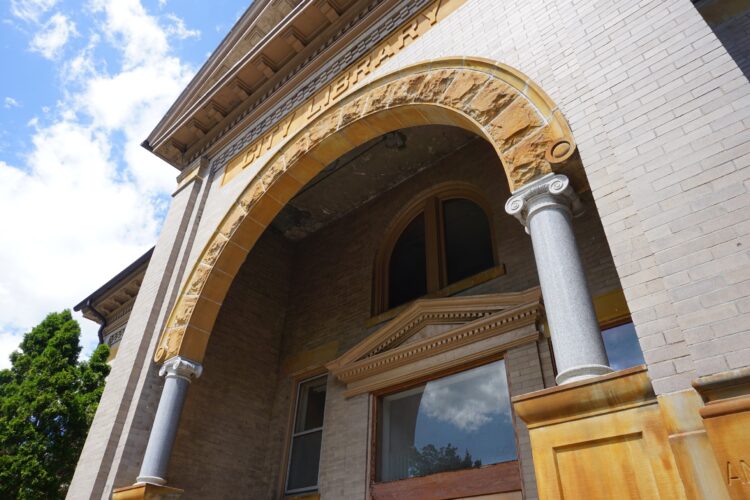
Read More: Traverse City’s Carnegie Library
When Did the Traverse City State Hospital Close?
The Traverse City State Hospital operated successfully for 101 years, closing in 1989. In the 1970s and 80s, many of the buildings, particularly the cottages, were sold or redistributed to other entities, including the Grand Traverse Pavilions (senior care home), Garfield Township, and developers such as the Minervini Group.
The 1980s had started with promise. President Jimmy Carter signed the Mental Health Systems Act of 1980, an executive order designed to fund local and state-run mental health centers. The order was passed in the final months of the Carter administration, leaving it exposed upon Ronald Reagan’s arrival.
Dialing back considerable momentum for mental health care, Reagan cut most of the MHSA’s programs and funding. The Omnibus Reconciliation Act of 1981 combined social service and mental health funding, limiting both how much funding would go to community mental health centers and how it could be allocated. Reagan ultimately repealed most of the funding for mental health and pushed costs onto states.
The repeal had a tragic effect on patient care. Closing mental health centers reduced the quality of care and patient supervision. It contributed to elevated levels of homelessness in many parts of the country, after spending its final years as the Traverse City Regional Psychiatric Hospital, shutdown in 1989.
Today’s Traverse City State Hospital: Tours, Housing, and Retail
Stop by Building 50, the center of the redeveloped campus, and you’ll likely find more than a few tours walking the grounds. Inventive stories of the Traverse City State Hospital’s “haunted” past certainly account for some of the site’s popularity. Still, the real draw is the undeniable beauty of the Victorian-Italante architecture, towering pines, and rolling green lawns.
Known as The Village at Grand Traverse Commons, the redevelopment process was a long, arduous journey. The campus was largely abandoned through the 1990s and at the turn of the millennium. In 2000, the Minervini Group struck a deal to renovate the rebuilt Building 50 (the original building was deemed a fire hazard in 1963 and demolished). The attached wings, which are original, are now fully occupied with offices, housing, restaurants, and retail spaces.
There are further plans to develop several remaining structures on the property, and newly constructed condos have popped up on the west side of the campus.
Celebrate Our Region’s History
Traverse Regional History Center is committed to telling the rich history of Northern Michigan through visual and audio media. Iconic and often complicated, the Traverse City State Hospital is a living chapter of the region’s vibrance and an indelible part of our story. Support our work by donating and stay tuned for more films, stories, and tales of Northern Michigan’s past.